What the chat can do
The assistant’s tools, example questions, memory and saved plans.
The assistant does not make up data: it looks it up with tools that read the game's official API, your data saved in Orbit and the calculators. You ask; it decides which tools to use and explains the result.

Its tools
Players and universe
- Search players by name or id: rank, points, status (inactive, vacation…) and alliance.
- Player profile: points and position in each category, planets and moons, alliance and observed activity (UTC hours in which something changed in the rankings).
- Rankings for the universe in any category, and alliances by name or tag.
- Map: players and planets in a range of systems, and marking players on the galaxy map.
- Scanner: finds players with no observed changes or with military losses, with filters. On Free, one run per week.
- Universe settings: speeds, galaxies, ACS, debris fields…
Calculators
- Cargo: how many cargo ships you need for a given amount of resources.
- Payback for a metal, crystal or deuterium mine level.
- Trade: 3:2:1 equivalents or your own rates.
- Expeditions: your fleet's points against the cap, plus a cargo check.
- Recyclers: how many you need, how many you have and how many are missing for a debris field.
- Combat simulator: chance of victory, rounds, losses, debris, loot if you win and balance, also with ACS allies. It is an estimate, not the server's exact result.
- Flights: duration and UTC departure and arrival times; it can work backwards from the impact time you want.
- Return-fleet hunting: if you know when an enemy fleet arrives, it works out when to leave to catch it on its way back, with the exact time for every possible speed.
- Interplanetary missiles: range, flight time and a salvo against defences.
Your data
- Your saved reports (and importing an
sr-orcr-code pasted into the chat). - Your fleet, defences and technologies per planet or moon (see Your Empire and fleets).
- An attack dossier in a single query: report, origin fleet, the target's observed activity and what is still unknown.
- Your memory and your saved plans.
Example questions
- “Find inactive players with a moon between 3:100 and 3:150 with more than 200,000 points.”
- “What activity has been observed for Kairo Vantis this week?”
- “Simulate 60 cruisers and 25 large cargoes against this report and tell me the balance.”
- “I want to hit 3:122:8 at 21:52:12 UTC. What time do I leave at 80% speed?”
- “Their fleet reaches my moon at 04:10:30. When do I leave to catch it on the way back?”
- “How many recyclers do I need for 180,000 metal and 60,000 crystal?”
- “Is it worth upgrading my crystal mine to level 24?”
The more specific the question (coordinates, speeds, ships), the better and cheaper the answer.
Context, files and notes
- Add context (the + button in the text box) gives the assistant your Empire and economy, your intelligence or your calculators.
- You can attach a file (.txt, .md or .json) of up to 24 KB.
- Your personal Notes and files accompany your queries.
- With the Max plan, Deep thinking appears: it reasons more thoroughly and checks calculations with tools. It uses more energy.
Saved plans
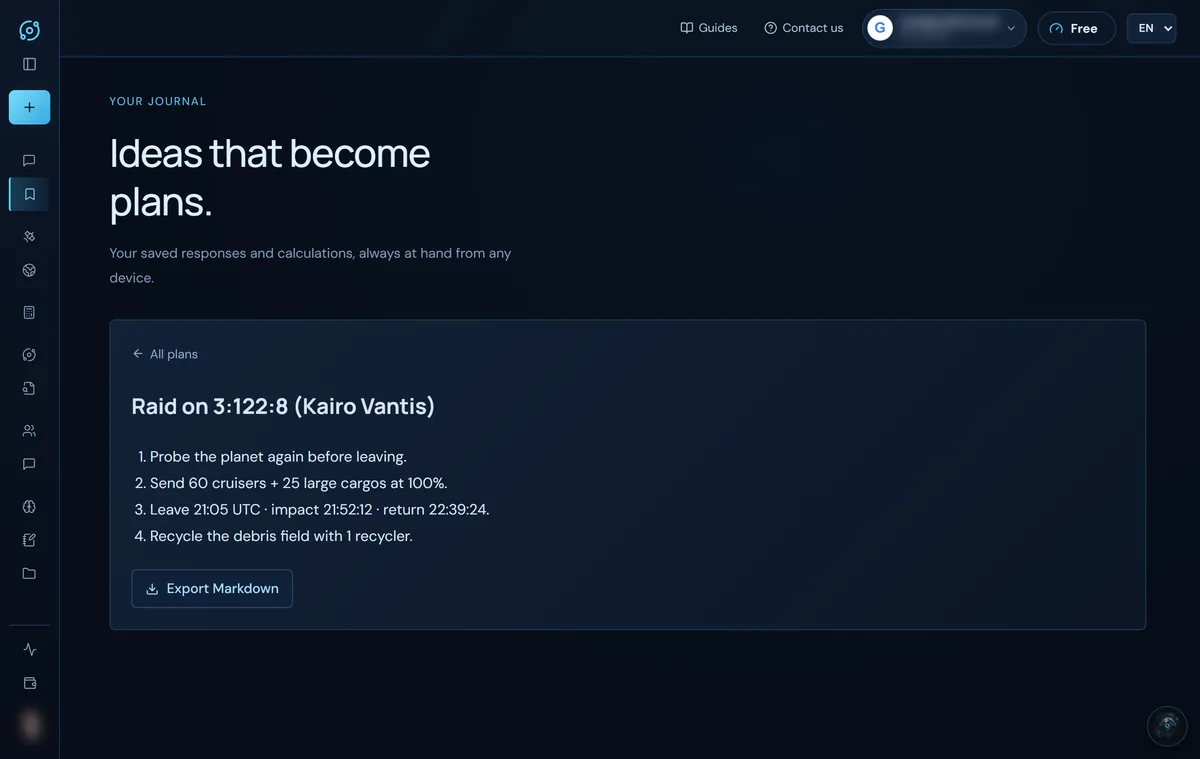
Below each answer there is a Save plan button. Plans are saved to your account (up to NaN per universe), appear in Saved plans and can be exported as Markdown. You can also ask the assistant to save or update a plan.
Memory
The assistant remembers what you tell it explicitly (“my goal is…”, “I never attack…”) and uses it in your personal conversations. You are in control in Memory · Fast / Mid / Deep:
- Fast: recent observations; they expire after 30 days.
- Mid: strategies and confirmed knowledge by topic.
- Deep: lasting rules. They are only saved if you confirm them; nothing moves to Deep automatically.
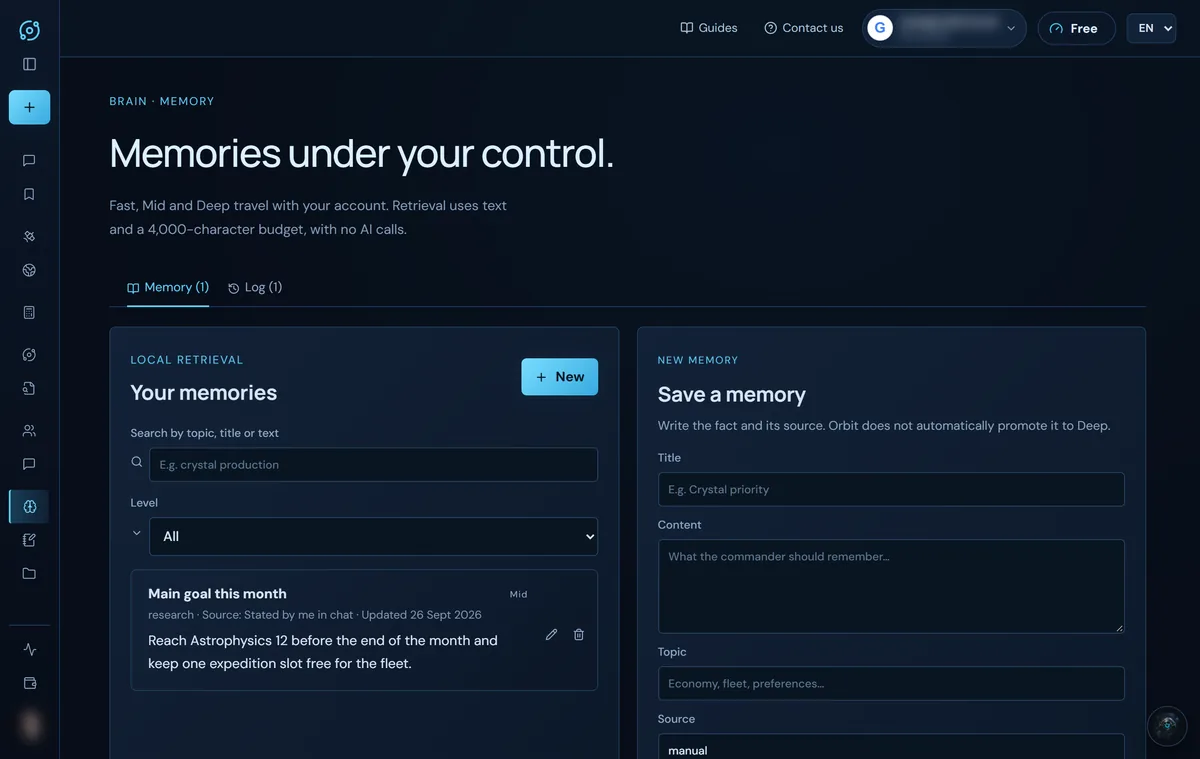
You can create, edit, search and delete memories (up to 500 active per universe). The Log keeps the before and after of every change. Your personal memory is not used in alliance chats.
Calculators without AI
If you don't need a conversation, the Calculators section has the battle and missile simulator, expeditions, flight and trade. They run in your browser, show their assumptions and use no energy.
Screenshots show the English interface with sample data; player names are fictitious.